Chinese Manufacturer or Trading Company? How to Tell
The question is not whether traders are bad. It is whether you know who is doing what.
Quick Answer
Do not rely on the answer to "Are you a factory?". Check the registered entity, factory address, production staff, equipment, certificates and which processes are performed in-house. A trader can be a perfectly workable supplier. The commercial risk appears when the buyer assumes direct factory control but critical production is handled by an undisclosed third party.
From the China side
A trader that openly names the factories and explains who controls each process is often easier to work with than a supposed manufacturer that becomes vague as soon as you ask where moulding, coating or assembly happens.
Practical reference
| Signal | Manufacturer pattern | Trader / intermediary pattern | What to verify |
|---|---|---|---|
| Product range | Often narrower and process-linked | May cover several factories or categories | Do not decide from catalogue breadth alone |
| Technical answers | Direct access to process constraints and equipment | May need to relay questions | Who answers detailed engineering questions? |
| Factory evidence | Facility, staff and equipment can be tied to entity/relationship | Production may sit with named third parties | Identify the critical production site |
| Certificates | Often tied to factory/legal entity | May belong to represented factory | Check entity and product scope |
A buyer asks a supplier, 'Are you a factory?' The answer arrives immediately: 'Yes, we are manufacturer.'
That exchange proves almost nothing.
In China, the commercial chain around a product can include the factory, a trading company, an export entity, a group company and subcontractors. Trying to reduce all of that to a yes-or-no question creates more confusion than clarity.
Why does manufacturer vs trading company matter?
The distinction matters for practical reasons. A factory may give you better access to engineering, process changes and production scheduling. A trader may be better at combining categories, handling small quantities, communicating in English or managing several factories.
The wrong model is not automatically expensive. The hidden model is dangerous because you make assumptions about control that may not be true.
How can you tell if a Chinese supplier is a factory or trader?
A manufacturer usually has a narrower relationship with process and product. Its answers tend to become more specific when you ask about tooling, line capacity, material handling, inspection equipment or production constraints.
A trader often has a broader catalogue and may move quickly between unrelated categories. Again, that is not a conviction. Large groups can make many products; specialist traders can focus on one industry.
What matters is whether the evidence fits the story.
- Does the registered business scope support manufacturing activity?
- Does the company use a factory address that can be tied to the same entity or a clearly related one?
- Can it show the relevant production area live, not only send edited promotional video?
- Who employs the production and QC staff?
- Which processes are done in-house and which are outsourced?
- Whose name appears on certificates, test reports and factory documents?
Who controls production when several companies are involved?
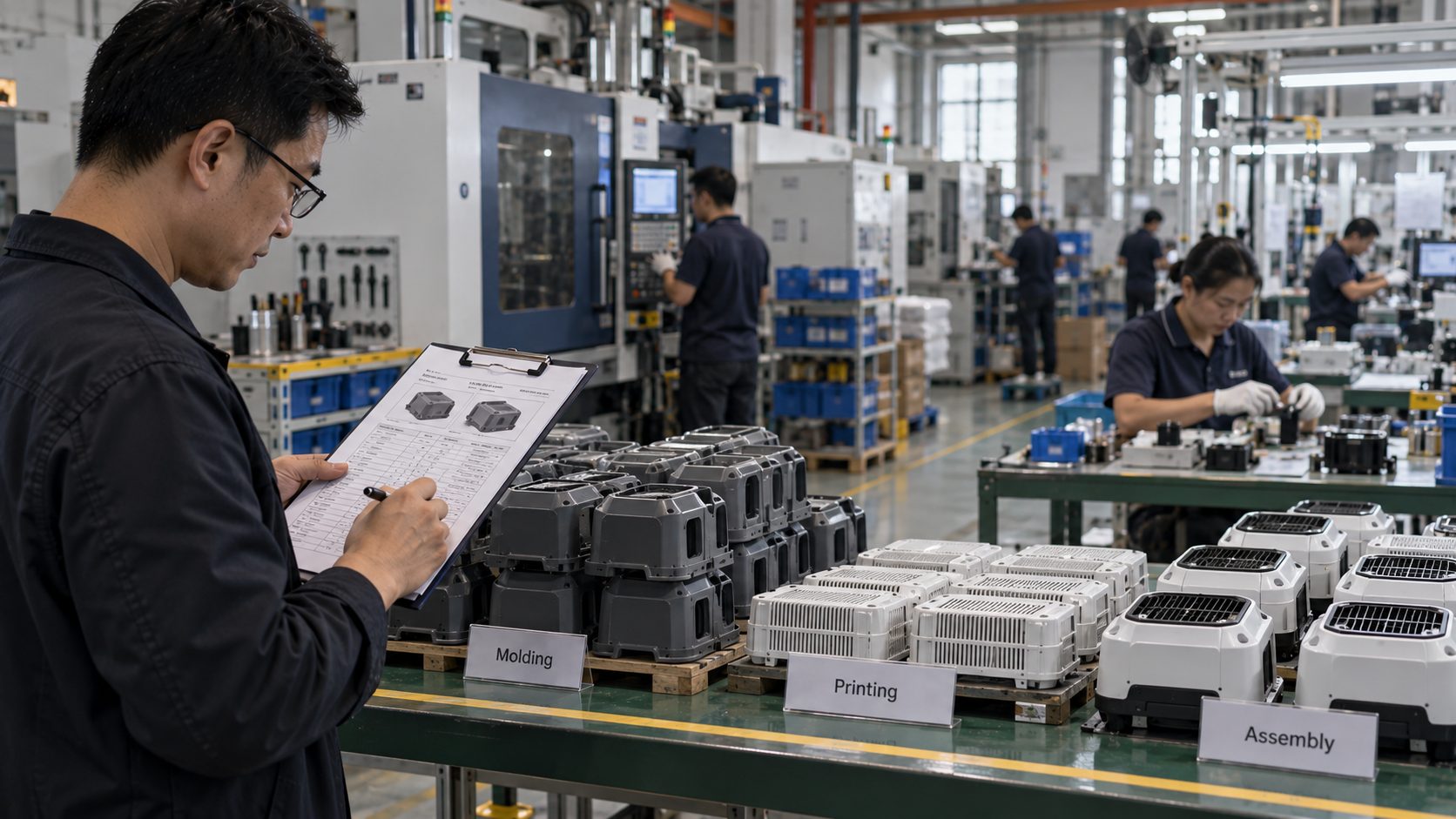
Suppose a trading company openly tells you that injection moulding is done by Factory A, printing by Factory B and final assembly under its own supervision. You can inspect that structure and decide whether it works for your order.
Now compare that with a supplier claiming to own a factory but refusing to identify where a critical process happens. The second supplier may still deliver good goods, but you have less visibility over the part of the chain that matters.
Transparency is often more useful than the label on the business card.
When can a Chinese trading company be the better supplier?
If you are buying five related products at modest quantities, a trader may solve a real coordination problem. It can aggregate orders, manage several factories and give you one commercial interface. A direct factory might simply refuse three of the five products or demand separate MOQs.
The cost of the intermediary should be weighed against the work it removes and the control it provides. 'Direct factory' is not a strategy by itself.
When does direct factory access matter?
For custom tooling, tight tolerances, repeated engineering changes, regulated products or high-volume production, direct access to the people controlling the process becomes more valuable.
If every technical question must travel through a salesperson, then a trader, then an engineer at an unnamed factory, small misunderstandings become slow and expensive.
How do you verify the relationship between a trader and factory?
Start with the legal entity and the documents, then move to the physical operation. If the supplier says it owns the factory, verify the factory. If it says the factory is a related company, establish the relationship. If it says production is subcontracted, identify the subcontractor for the critical processes.
Before committing money or tooling, establish who is responsible for production and who controls the critical processes.
Not sure who controls production? Supplier Verification →. If the open question is physical rather than corporate, Factory Audit → can settle it directly.
Sources
- Official Chinese enterprise registry for identity and registration checks
- SAMR: Unified Social Credit Code management rules